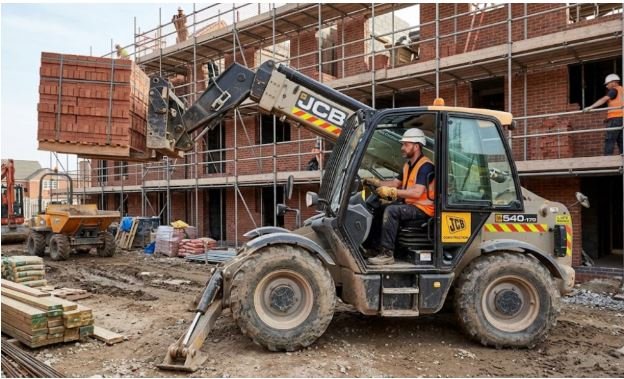
When to Use a Telehandler on Your Construction Site
You’ve got a deadline, a delivery of roof trusses sitting on the ground, and the forklift on site can’t reach the second floor. Sound familiar? Using the wrong machine for a job doesn’t just slow things down — it can cost you in labour, damage, and rescheduled trades. Knowing when to bring in a telehandler is one of those decisions that separates a smooth-running site from a chaotic one.
A telehandler — short for telescopic handler — is a rough-terrain machine with an extendable boom that lifts, reaches, and places heavy loads in locations other machines simply cannot access. It’s part forklift, part crane, and part all-terrain workhorse. This article breaks down exactly when a telehandler is the right call, how it compares to other equipment, and what you need to know before hiring one.
If you’re working in the greater Sydney area and need one for an upcoming project, telehandler hire Sydney is available through Longreach Access, with a range of models suited to different site conditions and project scales.
What Is a Telehandler and Why Do Construction Sites Use Them?
A telehandler uses a hydraulic telescoping boom mounted at the rear of the cab. That boom can extend both upward and outward, giving the operator the ability to place loads at height or reach forward over obstacles — without moving the machine into position directly beneath the target.
Unlike a forklift, which lifts loads straight up along a vertical mast, a telehandler can reach over a wall, drop materials into an upper floor opening, or place pallets on scaffolding from a safe distance. Most models handle lift capacities between 2,500 kg and 5,500 kg, with boom heights ranging from 6 to 17 metres depending on the model.
Built for outdoor, uneven terrain, telehandlers come with four-wheel drive, large aggressive tyres, and stable weight distribution that lets them operate on the kinds of ground conditions that would stop a standard forklift cold.
Common Attachments and What They Do
One of the biggest advantages of a telehandler is its ability to swap attachments and change roles on the fly. Pallet forks are the default — used for moving brick stacks, bagged concrete, steel bundles, and palletised materials. A bucket attachment turns the machine into a loader for moving loose material, debris, or soil. A lifting jib transforms it into a compact crane for picking up steel beams or awkward loads. And a personnel work platform allows certified operators to elevate workers to height safely — something a standard forklift cannot legally do on most sites.
5 Situations Where a Telehandler Is the Right Machine
Not every job needs a telehandler. But in the following situations, it’s often the most efficient and cost-effective choice on site.
1. Lifting Materials to Upper Floors or Roof Level
This is where a telehandler earns its keep. Roof trusses, wall frames, ridge beams, roofing materials, and flooring systems all need to go up — and a forklift’s vertical mast simply doesn’t have the reach or the horizontal extension to place them accurately. A telehandler can lift these loads to heights of up to 17 metres on larger models and place them precisely, with the operator controlling the boom angle and extension from ground level. On residential and commercial builds alike, this is one of the most common use cases.
2. Working on Rough or Uneven Terrain
Construction sites in Sydney — particularly in outer suburbs, greenfield developments, or sites with excavated areas — rarely offer the flat, paved surfaces that a standard forklift needs. Telehandlers are purpose-built for this. Four-wheel drive, high ground clearance, and rough-terrain tyres mean they can navigate muddy ground, slopes, and uneven surfaces without getting bogged down. If your site is unpaved or has grade changes, a telehandler is almost always the better choice over a forklift.
3. When You Need One Machine to Do Multiple Jobs
Hiring separate equipment for every task adds up fast. A telehandler with the right attachments can function as a material handler in the morning, a compact crane substitute at midday, and a personnel platform in the afternoon. For small to medium construction projects where budget and space are tight, that versatility reduces the number of machines you need on site at any given time. One operator, one machine, multiple functions — that’s the appeal.
4. Unloading Heavy Deliveries on Tight Sites
Delivery trucks can’t always get close to where materials need to go. A telehandler’s extended reach means you can unload pipe bundles, steel sections, or palletised materials from one side of a truck and place them directly where they’re needed — without having to double-handle. On tight urban sites in Sydney’s inner suburbs where access is limited, this reach advantage is invaluable. It speeds up unloading and keeps foot traffic away from the truck zone.
5. Elevating Workers Safely with a Work Platform
When fitted with an approved personnel work platform attachment, a telehandler can safely elevate workers for tasks like installing cladding, fixing window frames, or working on external walls. This is subject to strict safety requirements — operators must be certified, and the platform must be rated for the task. But for sites that already have a telehandler on hire, adding a work platform can eliminate the need to bring in a separate boom lift or scissor lift for certain jobs.
Telehandler vs Forklift vs Crane: Which One Do You Actually Need?
This is the question most site managers wrestle with. Here’s the short version.
A forklift is the right machine for short-range lifts on flat, paved surfaces — think warehouse floors, loading docks, or sealed hardstands. The moment the ground gets soft or you need to reach over an obstacle, it starts to fall short.
A crane is unmatched for very heavy lifts at great heights — structural steel, concrete panels, and large prefabricated sections. But cranes require significant setup time, a qualified dogman, and take up a lot of site space. For tasks that don’t hit that extreme end of the weight and height spectrum, a telehandler is usually faster, cheaper, and easier to mobilise.
A telehandler sits in the middle — versatile, mobile, capable on rough ground, and able to handle most day-to-day material placement tasks on a typical construction site. If you’re asking yourself whether a crane is overkill but a forklift won’t reach, a telehandler is almost certainly what you need.
How to Choose the Right Telehandler Size for Your Job
Telehandlers come in a range of sizes, and picking the wrong one is a common and avoidable mistake. The two key numbers are lift capacity (in kilograms) and maximum lift height (in metres).
Compact models — typically with a maximum reach of 6 to 9 metres and a capacity around 2,500 kg — suit smaller residential builds and tight sites where manoeuvrability matters more than raw reach. Mid-range models with a 10 to 13 metre lift height and 3,000 to 4,000 kg capacity cover the majority of commercial construction tasks. High-reach models pushing 17 metres and beyond are suited for multi-storey work, roof-level placements on larger builds, and industrial sites.
One critical thing to understand: lift capacity decreases as the boom extends. A machine rated for 3,500 kg can only safely carry that load at a specific boom angle and extension. Always check the load chart for the model you’re hiring — and make sure the operator understands it before they start work.
Safety Basics You Shouldn’t Skip
Telehandlers are powerful machines, and the consequences of misuse are serious. A few non-negotiables before putting one to work on your site.
Only trained, certified operators should run a telehandler. In Australia, this typically means holding a High Risk Work Licence for forklift operation, with additional training specific to telescopic handlers. Operators need to understand load charts, terrain assessment, and attachment changes.
Before every shift, the machine should be inspected — tyres, hydraulic lines, boom condition, forks, brakes, and warning devices. Travel with loads low and tilted back. Use a spotter in congested areas or when visibility is limited. Never lift personnel without an approved platform attachment. And always respect the load chart — exceeding rated capacity is one of the leading causes of telehandler tip-overs.
Is Hiring a Telehandler the Smarter Move?
For most construction businesses in Sydney, hiring a telehandler makes more financial sense than purchasing one outright. Purchase prices for mid-range models start around $80,000 and climb well past $150,000 for high-reach or heavy-duty configurations. On top of that, you’re looking at ongoing maintenance, storage, and compliance costs.
Hiring lets you match the machine to the specific job — different model for a residential frame-up versus a commercial cladding project. You get a well-maintained machine, delivery and pickup handled, and no long-term liability. For project-by-project work, it’s simply more practical.
Final Word
A telehandler earns its place on your site when you’re dealing with elevated placements, rough terrain, heavy deliveries, or a need for one machine to handle multiple roles. It’s not always the answer — but when the conditions call for it, nothing else comes close. Get the sizing right, put a certified operator behind the controls, and respect the load chart. The machine does the rest.
