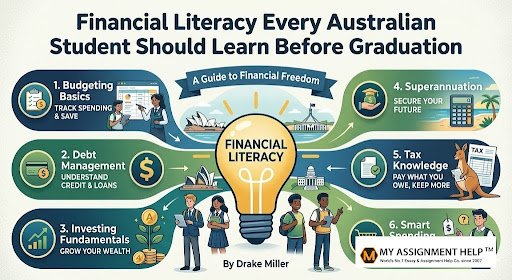
Financial Literacy Every Australian Student Should Learn Before Graduation: A Guide to Financial Freedom
The transition from high school or university into the “real world” is one of the most significant milestones in an Australian student’s life. However, while our education system is world-class at teaching Pythagoras’ theorem or the causes of the Industrial Revolution, there is often a glaring gap: practical financial literacy.
For many young Australians, graduation comes with a newfound sense of freedom, but also a complex web of financial responsibilities. Many find that seeking professional assignment help for students allows them the time to focus on these real-world skills while maintaining their grades. From managing HECS-HELP debts to understanding the magic of compound interest, the decisions made in your early 20s can dictate your financial trajectory for decades.
In this comprehensive guide, we break down the essential financial pillars every Australian student should master before they toss their cap in the air.
1. The Power of Compound Interest (and the Danger of Debt)
Albert Einstein famously called compound interest the “eighth wonder of the world.” For a student, it is your greatest ally or your worst enemy.
The Sunny Side: Investing Early If you start investing just $50 a week at age 20 into a diversified index fund with an average 7% return, by the time you reach 60, you could be looking at a portfolio worth over $500,000. The key isn’t the amount; it’s the time. Starting five years earlier can result in a difference of six figures by retirement.
The Dark Side: Consumer Debt On the flip side, credit cards and “Buy Now, Pay Later” (BNPL) services like Afterpay or Zip can lead to a debt spiral. In Australia, the convenience of tapping a phone to pay has made it easy to lose track of spending.
Comparison: Understanding Your Debt
| Feature | HECS-HELP (Student Debt) | Consumer Debt (Credit Cards/BNPL) |
| Interest Rate | 0% (Indexed to CPI only) | 15% – 25% |
| Repayment Trigger | Only when you earn above a threshold | Immediately / Monthly |
| Impact on Credit | Minimal (unless in default) | High (can prevent home loans) |
| Best Strategy | Pay the compulsory amount | Avoid or pay off in full monthly |
2. Navigating the HECS-HELP System
Most Australian students graduate with a HECS-HELP debt. While it is often called the “best debt you’ll ever have” because it is interest-free, it isn’t “cost-free.”
Student loans in Australia are indexed to the Consumer Price Index (CPI) every June 1st. When inflation rises—as seen in recent cycles—your debt grows even without interest. It’s crucial for students to understand how compulsory repayments work. Once your income hits the minimum threshold (currently around $54,000, though this adjusts annually), the ATO automatically deducts a percentage of your pay.
Pro-Tip: If you are struggling with the quantitative side of your degree, getting accounting assignment help can help you better understand the principles of taxation and debt indexing that apply to your own life.
3. Mastering the “Bucket” Budgeting Method
Budgeting sounds restrictive, but it’s actually about giving yourself permission to spend. One of the most effective methods for Australians is the “Bucket” system.
As a student, you should aim to categorise your income into three main buckets:
- Blow (Daily Expenses) – 60%: This covers your “must-haves” like rent, groceries, transport, and phone bills.
- Mojo (Safety Net) – 20%: A percentage tucked away in a high-interest savings account for emergencies, like a broken laptop or car repairs.
- Grow (Long-term Wealth) – 20%: Money intended for investments or a future home deposit.
By automating these transfers on pay day, you remove “decision fatigue.” You know exactly how much “guilt-free” money you have left for socialising without dipping into your rent money.
4. Understanding Superannuation: It’s Your Money
Many students view Superannuation as a distant concept for “old people.” In reality, your Super is likely one of the most valuable assets you will ever own.
When you start your first part-time job or internship, your employer is legally required to contribute a percentage (the Super Guarantee) of your earnings into a Super fund.
- Consolidate Your Accounts: If you have had multiple casual jobs, you likely have multiple Super accounts. Each one charges insurance premiums and administration fees. Use myGov to consolidate these into one fund.
- Check the Investment Option: Most young people are defaulted into “Balanced” funds. However, since you have a 40-year horizon before retirement, “High Growth” options—which lean more into shares and property—typically provide much higher long-term returns for those who can weather short-term market volatility.
5. The Basics of the Australian Stock Market (ASX)
You don’t need to be a “Wolf of Wall Street” to build wealth. For students, the barrier to entry has never been lower. Platforms like CommSec Pocket, Pearler, or Raiz allow you to invest small amounts into Exchange Traded Funds (ETFs).
An ETF is like a basket of stocks. Instead of betting on one company, you can buy a tiny piece of the top 200 Australian companies (the ASX 200). This diversification reduces risk and allows you to grow in tandem with the Australian economy.
6. Taxes, the ATO, and Hidden Offsets
The Australian tax system can be daunting for a new graduate. Before entering the full-time workforce, every student should know:
- Tax-Free Threshold: You don’t pay tax on the first $18,200 you earn in a financial year.
- Low Income Tax Offset (LITO): If you earn below certain thresholds, the government provides a tax offset that can reduce the tax you owe to zero.
- The Medicare Levy: Most Australians pay 2% of their taxable income to fund Medicare. However, if you are a low-income student, you may be eligible for a reduction or exemption.
- Work-Related Deductions: If you use your personal laptop for study-related work or buy specific protective uniforms for a placement, you may be able to claim these to reduce your taxable income. Keep your receipts!
7. Building a “Safety Net” (The Emergency Fund)
Life happens. Whether it’s a sudden medical bill or a period of unemployment after graduation, having an emergency fund is the difference between a minor setback and a financial crisis.
Aim to save at least $2,000 as a “starter” emergency fund while studying. Once you graduate and move into full-time work, the goal is to expand this to cover 3–6 months of living expenses. This “Mojo” money should be kept in a separate bank—out of sight, out of mind—so you aren’t tempted to use it for a weekend trip.
8. The Psychology of Spending and Social Pressure
In the age of Instagram and TikTok, “lifestyle creep” is a real threat. Seeing peers on European summer holidays or driving new cars can create a false sense of what “normal” looks like.
Financial literacy isn’t just about numbers; it’s about mindset.
- Assets vs. Liabilities: An asset (like an ETF or an education) puts money in your pocket or increases your earning potential. A liability (like a car loan or a designer bag) takes money out of your pocket.
- The 48-Hour Rule: Before making a non-essential purchase over $100, wait 48 hours. Usually, the “dopamine hit” wears off, and you’ll realize you didn’t need it.
9. Protecting Yourself: Insurance and Scams
Australia has seen a massive spike in sophisticated phishing and bank scams. Students are often prime targets for “Remote Access” scams or “Hi Mum” WhatsApp messages.
- TFN Security: Your Tax File Number is as private as your bank PIN. Never share it via email.
- The “Too Good to Be True” Rule: If an investment on TikTok promises 10% returns a week, it is a scam.
- Essential Insurance: While you might not need life insurance yet, having Contents Insurance for your rental or Third-Party Property Insurance for your car is non-negotiable.
10. How to Seek Help and Manage the Load
Sometimes, the pressure of balancing studies and finances becomes overwhelming. Financial stress is one of the leading causes of academic burnout among Australian students.
For academic support, many students utilize services like Myassignmenthelp.services to manage their heavy workloads. Just as a business might outsource a task to remain efficient, students use these platforms to clear their schedules, allowing them more time to focus on professional development, internships, and financial planning.
Financially, if you find yourself in over your head, the National Debt Helpline (1800 007 007) offers free, confidential advice from professional financial counsellors who can help you negotiate with creditors or manage HECS concerns.
Frequently Asked Questions
Q.1 Should I pay off my HECS-HELP debt early?
Generally, no. Since HECS-HELP is only indexed to inflation and has no interest, it is usually better to invest your extra cash into assets that grow faster than inflation (like ETFs) or put it toward a home deposit.
Q.2 What is the best high-interest savings account for students in Australia?
Look for accounts specifically designed for young adults (under 30 or under 25). These often offer bonus interest rates if you make a monthly deposit and no withdrawals. Use comparison sites like Canstar or Finder to find the current top rates.
Q.3 Can I claim my university textbooks on my tax return?
Only if the study is directly related to your current job. If you are studying to get a new job, you generally cannot claim these expenses. Always check the latest ATO guidelines for “self-education expenses.”
Q.4 What is a “good” credit score in Australia?
Unlike the US, Australian credit scores aren’t used for everything, but they matter for loans. A score above 700 is typically considered “good.” You can check yours for free via providers like Equifax or Experian.
The Path Forward
Graduation is the start of a new chapter. By mastering these ten pillars, you aren’t just earning a degree in your chosen field—you’re earning a “degree” in life.
Financial literacy isn’t about being rich; it’s about having the freedom to make choices. Start small, stay consistent, and remember: the best time to start managing your money was yesterday. The second best time is today.
About the Author
I am a passionate blog author and academic mentor associated with Myassignmenthelp.services. With a strong commitment to guiding students, I create insightful content that simplifies complex subjects and supports academic success. My role involves mentoring learners, enhancing their writing skills and helping them meet educational goals. Through my blogs, I aim to provide practical advice, reliable resources, and motivation for students striving to excel in their studies.
