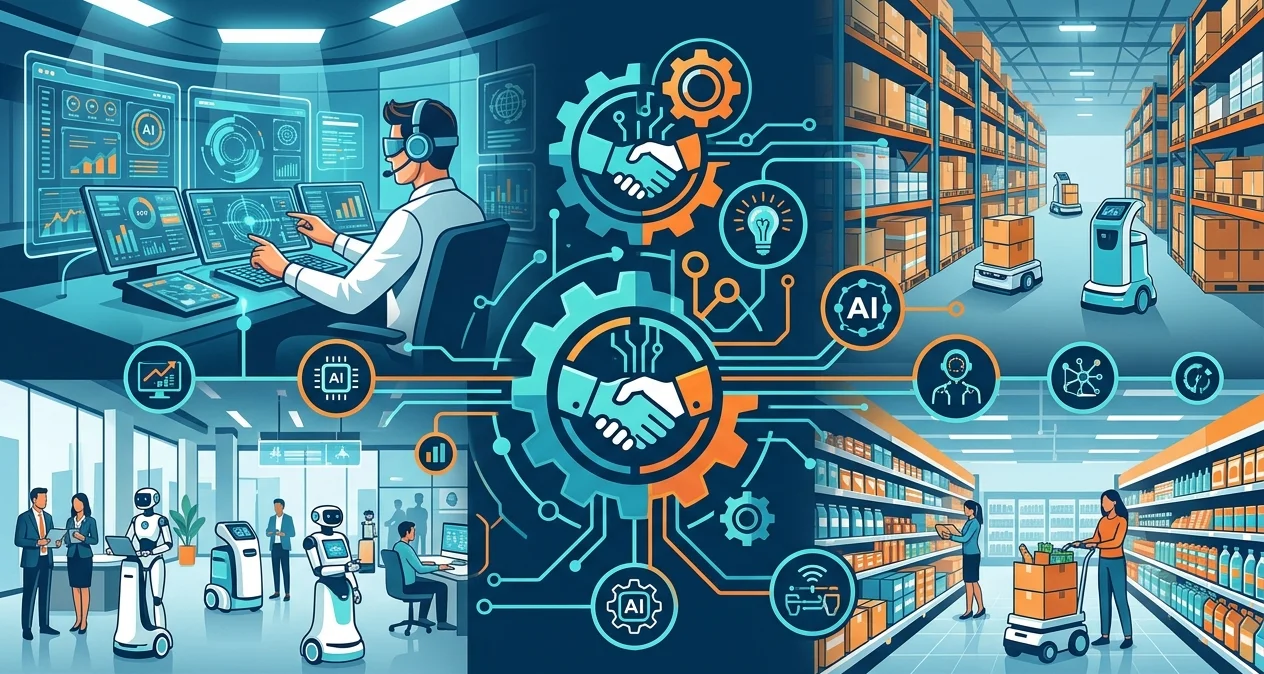
How Remote Robot Operators Are Revolutionizing Autonomous Robotics in Commercial Spaces
The rapid evolution of artificial intelligence has brought us to a pivotal moment in industry: the transition from rigid automation to dynamic, human-augmented systems. While the promise of fully autonomous robots remains the industry’s North Star, commercial spaces are often too chaotic for legacy software to navigate alone. To bridge this gap, businesses are increasingly relying on the “Human-in-the-Loop” (HITL) model. By empowering human operators to guide robotic systems through complex, unstructured environments, companies are finally moving past the limitations of pre-programmed tasks to unlock true operational intelligence.
🤖 The Rise of Remote Robot Operations
The rise of remote control technology, supported by high-speed communication networks like 5G, has turned the traditional concept of onsite supervision on its head. Today, Remote-Controlled Robots, ranging from mobile logistics units to dexterous robotic arms, are being operated from centralized hubs. This shift is not merely about convenience; it is a tactical response to the persistent labor shortage that plagues many sectors.
By utilizing a VR interface or a virtual environment, operators can achieve a sense of “telepresence,” manipulating machines with high-precision feedback. Whether it is an industrial environment where heavy machinery must be handled with care or a cleanroom requiring fine motor skills, remote robotics allows specialized workers to manage multiple sites from a single location, effectively decoupling labor from geography.
🏢 Why Commercial Spaces Need Human-in-the-Loop Robotics
The Human-in-the-Loop (HITL) feedback cycle: Human interventions solve immediate edge cases while simultaneously training the robot’s machine learning models for better future autonomy.
Commercial spaces, such as hospitals, airports, and retail centers, present a unique “edge case” problem. Unlike a factory floor, these environments are shared with humans, making them highly unpredictable. Autonomous robots often freeze when faced with human-robot interaction challenges, such as a crowded lobby or a misplaced obstacle.
An automated system can often stop working without people to help, which can slow things down. Companies are creating smarter systems by using machine learning that improves with the help of humans. When someone helps a robot get past a spill or an unexpected object, the robot learns from this to improve how it avoids obstacles and recognizes objects in the future. Having humans work together with smart computers is key to growing big over time.
⚙️ Key Benefits of Remote Robot Operators
The adoption of remote operation is fundamentally shifting the ROI of automation. Key benefits include:
- Reduction of Human Error:By utilizing advanced sensors and high-definition vision systems, operators can manage tasks with surgical precision, reducing accidents that cost industries millions annually.
- Cost Savings:By streamlining manufacturing processes and optimizing assembly lines, companies reduce downtime and increase throughput.
- Worker Safety:Removing personnel from hazardous environments such as high-heat areas, radiation zones, or deep-sea applications is a massive leap forward in workplace safety.
- Predictive Analytics:Remote systems enable constant remote monitoring, allowing managers to identify mechanical wear before it becomes a failure, thus enabling predictive maintenance across entire fleets.
🌐 Applications Across Commercial Industries
The versatility of this technology is staggering. Robots and automated vehicles help people speed up managing and distributing inventory in the supply chain. In the medical field, the impact is even more profound. Doctors can now use robots to help them do complicated surgeries, like replacing a knee or putting in a cochlear implant, even from a distance.
Medical robots are changing how patients are treated. They help with things like endoscopes and radiosurgery, making decisions easier for doctors. In simple terms, these systems work as a labor force on the International Space Station, showing that once machines are perfected remotely, they can be used even in far-off human activities.
📊 Enhancing Automation with Smart Monitoring
Effective automation relies on the Internet of Robotic Things (IoRT). Operators can see a digital model of the physical space in a virtual cockpit, getting a steady flow of 3D visuals and sensory information. This level of transparency ensures that industrial robotics is never a “black box.”
The system uses sensors to quickly tell people when something’s not working right. The robot gathers data, the human corrects it, and the AI-powered robots get better at what they do over time. This framework helps us work faster and is also important for meeting safety rules, which was talked about in the European Parliament’s discussion on automation ethics.
🚀 The Future of Robotics in Commercial Spaces
The future of automation is not an “either-or” scenario; it is an integrated ecosystem. Thanks to things like the Roboverse Reply, we’re headed toward smoothly mixing virtual and real worlds. In the future, we’ll be able to train robots to think like humans by watching how people do things, thanks to deep learning.
Conclusion
Robots working well with people are really important for them to succeed in business. Using remote-control technology, such as robot teleoperation and robot monitoring services, helps companies avoid mistakes, deal with worker shortages, and save a lot of money.
Having people involved at key points is the best way to make automation big and dependable, from manufacturing in factories to advanced robotic-assisted surgery. As we look to the future, businesses that invest in these hybrid interfaces today, turning robots into extensions of human expertise, will lead the next generation of industrial innovation.
