How Numerology Apps Actually Calculate Your Numbers
Most people meet numerology through an app, which means most people meet it as a black box: you enter a birth date, a screen loads, and a paragraph about your soul’s purpose appears. Whether that paragraph is worth anything depends entirely on arithmetic you never see.
This piece opens the box. Not because you need to do the maths yourself, but because knowing what is supposed to happen is the only way to tell a carefully built tool from a text generator with a date field.
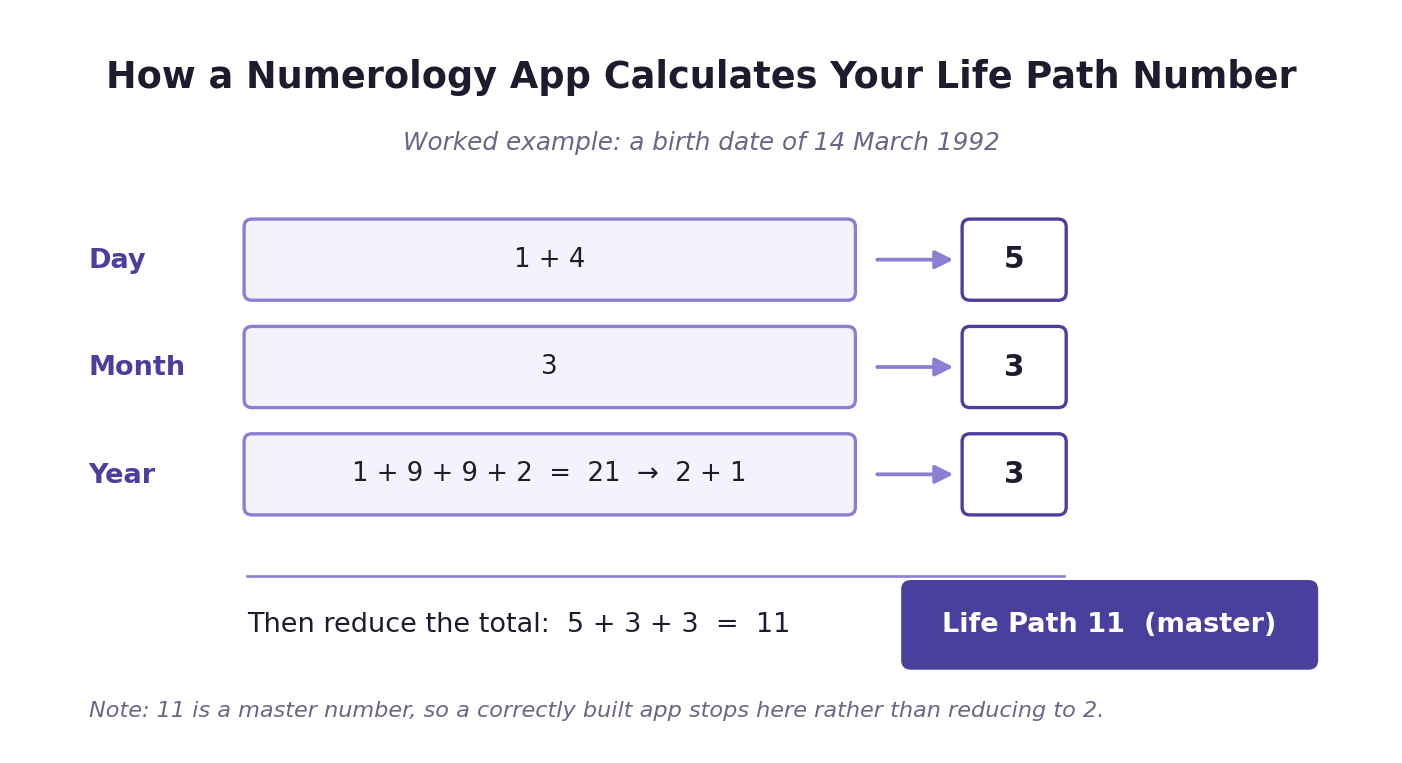
Image: How a numerology app calculates your Life Path number
The Life Path: the calculation everything else hangs on
The Life Path number comes from your full date of birth, and the method matters more than people expect.
The correct approach reduces the day, month, and year separately, then adds those three results and reduces once more. Take 14 March 1992. The day, 14, becomes 1 + 4 = 5. The month, 3, stays 3. The year, 1992, becomes 1 + 9 + 9 + 2 = 21, which reduces to 2 + 1 = 3. Add the three components: 5 + 3 + 3 = 11.
And here the calculation stops, because 11 is a master number.
There is a shortcut method that simply adds every digit in the date at once. Most of the time it produces the same answer. Occasionally it does not, because reducing components separately preserves master numbers that a straight digit sum would flatten. An app that uses the shortcut will quietly misreport a small percentage of its users, and those users will never know.
Why master numbers are the honest test
Eleven, twenty-two, and thirty-three are treated in most traditions as master numbers — not reduced further, and carrying distinct meanings. Eleven is generally associated with intuition and sensitivity, twenty-two with the capacity to build at scale, thirty-three with teaching and service.
Whether you find that framework meaningful is a separate question. What matters technically is that handling them requires the developer to write a conditional into the reduction loop, and plenty of them did not. This makes master numbers the fastest quality test available for any numerology app: if a chart that should return 11 returns 2, the arithmetic underneath is naive, and everything built on top of it inherits that.
The name calculations, and why they are harder
Three of the core numbers come from your name rather than your date, and this is where app quality diverges sharply.
Each letter is assigned a number. In the Pythagorean system, that assignment is straightforward alphabetical order: A is 1, B is 2, on through I as 9, then J restarts at 1. The Chaldean system uses a different mapping entirely and does not assign 9 to any letter.
From those values an app derives three numbers. The Expression number sums every letter of your full birth name. The Soul Urge sums only the vowels. The Personality sums only the consonants.
That sounds simple, and then reality intervenes. Is Y a vowel? Traditional practice says it depends on function — a vowel in “Lynn,” a consonant in “Yolanda” — which means correct handling requires linguistic logic rather than a lookup table. What happens to hyphens, apostrophes, accented characters, non-Latin scripts, suffixes like Jr? Which name counts when someone has changed theirs?
The convention is that the full name as recorded at birth governs the core numbers, with any adopted name treated as a secondary influence. An app that never asks the question is not applying the convention; it is ignoring it.
Cycles: the calculations that change
Static numbers describe. Cyclical numbers give you something to check against, and they are where numerology becomes usable rather than decorative.
The Personal Year is derived from your birth day and birth month added to the current calendar year, then reduced. It runs 1 through 9 and restarts, with each position carrying a theme — beginnings at 1, consolidation and patience at 2, expression at 3, and so on to completion at 9. The Personal Month and Personal Day extend the same logic to shorter intervals.
These require an app to know today’s date, handle the rollover correctly, and — a detail many get wrong — decide whether the Personal Year turns over on 1 January or on your birthday. Traditions differ. Good apps say which they use. Most say nothing.
What the app does after the arithmetic
Once the numbers exist, an app has to turn them into text, and there are broadly three approaches.
The first is a fixed interpretation library: a written passage per number, retrieved and displayed. It is consistent, it is verifiable, and it is limited — you will see the same paragraph every time.
The second is combinatorial: passages that account for interactions between numbers, so a Life Path 8 with a Soul Urge 2 reads differently from a Life Path 8 with a Soul Urge 5. Considerably more work to build, and considerably more specific to read.
The third is generative, using a language model to write the interpretation fresh. This produces the most fluid text and carries a specific risk: a model asked to interpret numerology will produce confident, well-written output regardless of whether the numbers it was handed are correct. Fluency is not accuracy, and generated readings can mask arithmetic errors that a fixed library would expose.
Checking your app in three minutes
Reduce your own birth date by hand using the component method above. Compare it to what the app shows. If they differ, the app is using the shortcut or has a bug.
Then enter your full birth name and a shortened version, and see whether the Soul Urge and Personality numbers change. They should. If they do not, the name calculation is not running.
Finally, look for whether the app states its system anywhere. Tools such as Raka numerology that publish their method make this straightforward; apps that treat the calculation as a trade secret are asking you to trust output you have no way to verify.
The point of knowing this
You do not need to run these calculations manually. But knowing what should be happening changes how you read the output — you stop treating the app as an oracle and start treating it as a calculator with an interpretation layer attached.
That shift is worth making. The arithmetic is either right or wrong and can be checked in minutes. The interpretation is a matter of what you find useful. Confusing the two is how people end up trusting a beautifully designed app that has been quietly reducing their master number for a year.
